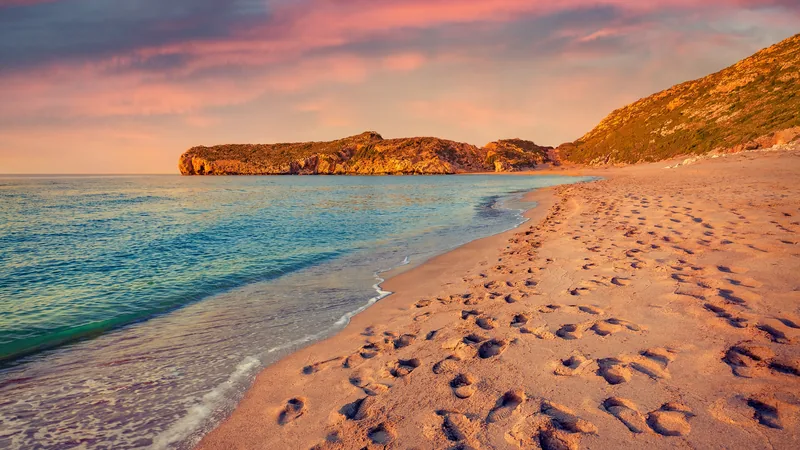
Stay 2 nights in Patara village. Beach in the morning before the day-trippers arrive (8.30–11am). Ruins after lunch when the heat drops. Sunset back at the beach. That’s the play.
Most Patara visitors come as a half-day trip from Kalkan or Kaş, see the ruins under a beating midday sun, walk 200 metres of beach, and leave by 4pm. They miss most of what Patara actually is. Stay overnight in the village instead — €40–90 a night in family pensions — and you get the empty beach at dawn, the ruins in cool late-afternoon light when the angled sun makes the carved stone read properly, and you have the place to yourself before the morning Kalkan dolmuş arrives. Combine with the Lycian Way (Stage 5 ends at Patara) for an unbeatable 2-day stop.
The beach — what makes it different
Patara beach is 12 km of fine yellow-white sand backed by dunes, with the Akdağ mountains rising behind. There are no hotels on the beach. There is no road along the beach. There are no umbrella-rental concessions stretched the full length. You enter through one gate, walk past the ancient harbour, and arrive at a single beach pavilion (toilets, café, sun lounger rental for ₺100/£3). From there, walk in either direction and within 5 minutes you’re alone.
The protection comes from three layered designations: the ruins are an archaeological zone (no building), the dunes are a strict ecological reserve, and the offshore zone is a SCEP (Specially Protected Coastal Environment) designation specifically for loggerhead turtles. Together these prevent the standard Mediterranean coastline development that turned every other beach this size into a continuous strip of resort hotels.
The water is clean, shelves gradually (good for kids), and the south-westerly afternoon swell sometimes produces small surf — Patara is one of very few Turkish beaches with rideable waves. There are sometimes weed mats on the sand after storms (sea-grass debris, not pollution). The dunes are walkable but fragile; stay on marked paths.
The ancient city — what to actually look at
Patara was the largest harbour city of ancient Lycia. From around 200 BC to AD 600 it was politically pre-eminent — the meeting place of the Lycian League, history’s first documented federal democracy. Excavations are still ongoing (the bouleuterion was reopened to the public in 2010 after restoration; lighthouse work concluded 2016). The site has more substantial standing structures than any other Lycian city you can visit, including Myra and Xanthos.
The bouleuterion (assembly hall)
The single most important building. The Lycian League — 23 federated city-states across Lycia — met here to vote on regional matters from approximately 200 BC. The structure was excavated, partially reassembled with surviving stone and modern infill, and reopened to the public in 2010 with a full roof. You can walk inside, sit in the senator seats, and (if you’re alone) get a sense of the acoustics that worked for political assembly. American constitutionalists Madison and Hamilton studied the Lycian model when designing the US federal system; they specifically cite Patara in Federalist No. 9.
The lighthouse
Built under the emperor Nero, the lighthouse marked the entrance to Patara harbour for almost a thousand years before silting closed the port. Excavated 2010s, partially rebuilt to ~12 m of original 18 m height, with the original engraved inscription naming Nero now displayed at the base. The earliest dated lighthouse anywhere in the Mediterranean — older than the Pharos lighthouse remains at Alexandria. The harbour itself is now grass and silt; you can walk the original quay line and see the harbour’s outlines.
The Roman theatre
Half-restored, half still in dunes. Climb to the upper rows for the view back across the bouleuterion to the harbour. Acoustics are still functional — drop a coin on stage and you’ll hear it from the top row. Performances do happen here occasionally during summer; check at the village.
The triumphal arch (Modestus Gate)
3-arched triple-passage gate built for the Roman governor Modestus, the most-photographed structure on site. Standing 10 m, fully intact, with the original inscription. Walk through it: this was the city’s formal entry from the north. The aqueduct that fed the city ran into the gate’s upper level — you can see the channel.
The colonnaded street + agora
The main avenue ran 1.5 km from the harbour to the city centre, lined with shops on both sides. Most of it is now low ruins — column drums, paving stones, foundations — but enough survives to read the urban plan. The agora opens off it at midpoint. Walk it slowly with the official audio tour (₺50, available in English at the gate).
How to visit — practical detail
Entry, hours, ticket
Single gate at the western end of the access road from Patara village. ₺200 (~£5/€6) for both ruins and beach. Open 8am–7pm summer (June–September), 8am–5pm winter. Queues: minimal except on Fridays in peak summer when day-trip groups from Kalkan arrive. Buy at the gate; the MüzeKart Plus annual pass (~₺1,500) covers Patara plus most other Turkish national-park sites.
How long to spend
Minimum 3 hours: 1 hour ruins, 2 hours beach. Recommended: a full day, or stay overnight and split across 2 mornings. The site has minimal shade — bring sun cream, a hat, water. Don’t do the ruins between 12pm and 3pm in summer; come early or late.
Getting around the site
Walking. The ruins cluster around the access road and harbour and are walkable in 1–1.5 hours at a slow pace. From the beach pavilion to the ruins is ~600 m. A free shuttle van runs every 15 minutes between the gate and the beach pavilion in summer.
Patara village (Gelemiş) — where to stay
Patara village (real name: Gelemiş) sits 1.5 km inland from the beach, far enough to keep it out of the protected zone. Around 1,500 residents, mostly engaged in tomato farming, pension-keeping, and tourism. Single main street, 15–20 small family-run pensions, 2–3 mid-range boutique hotels, half a dozen restaurants. Calm at night. Walking distance to the gate (15 min) or a free van every 30 min.
Pension tier (€40–70)
Family-run, breakfast included, often pool. Beyhan Pansiyon, Akay Pension, Patara View Point all sit in this tier and book out 2 weeks ahead in May/June and September/October peak. Walk-in works mid-week shoulder season.
Boutique tier (€70–130)
Patara Sea Hotel, Patara Garden Hotel, similar small boutiques. Slightly bigger rooms, better breakfasts, sometimes a quieter pool. Worth the upgrade for couples, less essential for backpackers.
Stay-with-the-family
A handful of families let single rooms in their homes for €25–40 incl. breakfast and (usually) dinner. Negotiate in person, in cash. The cheapest way to do Patara and often the most memorable.
Don’t bother with
The 4–5 large package-tour hotels at the village edge that mostly serve British charter groups; they’re fine but generic, and same money buys you the boutique tier in the village centre.
Combine Patara with
The Lycian Way (best combination)
Stage 5 of the Lycian Way ends at Patara (Letoon → Patara, 16 km, easy). Stage 6 (Patara → Kalkan, 16 km, moderate) starts the next morning. If you’re section-walking the western Lycian Way, Patara is the natural overnight in the middle of the most-walked block. Pension nights either side, and you finish each walking day at swimming water. Stage maps + GPX tracks on lycianway.co.uk.
Xanthos and Letoon (UNESCO double)
Both sites are 30 minutes drive from Patara village. Xanthos was the religious centre of Lycia (the famous Harpy Tomb is there; the original is in the British Museum, the cast is in situ), Letoon was its religious sister-site (sanctuary of Leto). Both UNESCO World Heritage. Half-day combined visit. Add to a Patara stop and you’ve done the three most significant western Lycian sites in 2 days.
Kalkan and Kaş for the evenings
Kalkan (15 km east) and Kaş (45 km east) have the dinner restaurants and bar atmosphere Patara village doesn’t. Day-trip Patara from a Kalkan/Kaş base, OR overnight Patara and dolmuş into Kalkan for an evening dinner.
Saklıkent Gorge
1 hour by car north of Patara. 18-km canyon you wade into for ~1 km on raised wooden platforms; cold mountain water, dramatic narrows. €5 entry. Combine with Tlos ruins (45 min from Patara) for a half-day alternative on a beach-rest day.
How to actually get to Patara
By private transfer
Dalaman airport (DLM) → Patara: 100 km, ~1h45m, €60–90 by pre-booked private transfer. The most common option for first-time visitors. See operator listings. Antalya airport (AYT) is much further — 230 km, ~3 hours, €120–180; only sensible if your inbound flight is into AYT.
By public transport
Dalaman airport → Fethiye otogar (1 hour shuttle, £5–8) → Kalkan or Kaş intercity bus (~£8) → Patara junction → dolmuş or 1.5 km walk into the village. Total: 4 hours, ~£15. Doable but slow if you have luggage.
From Kalkan or Kaş
Dolmuş runs every 30–60 min in season from both, ~£2 each way. Drops at the Patara junction; 1.5 km walk or hitchhike into the village. Easiest day-trip approach.
Best time to visit
April–early June: ideal. Wildflowers in the dunes, mid-20s°C, sea on the cool side (18–22°C) but warming. Few crowds.
Mid-June–early September: hot (32–38°C). Beach busy from 11am. Visit ruins early or late only. The most reliable swimming water (24–27°C) but expect day-trip coaches.
Mid-September–end October: excellent. Sea still 24°C, air 22–28°C, crowds thin out. The single best month for Patara is September.
November–March: winter. Beach often deserted. Most pensions close. Ruins still open and atmospheric in winter rain. Niche but rewarding.
Frequently asked
Where is Patara?
Patara is a coastal village and national park on Turkey’s south-west Mediterranean coast (the Lycian coast), 75 km east of Fethiye and 60 km west of Kaş. The site contains both Lycia’s ancient capital and Turkey’s longest undeveloped beach (12 km). Dalaman airport is 100 km / 1h45m by car; the village itself sits 1.5 km inland from the beach, with the ancient ruins between.
How much is Patara entry?
₺200 / ~£5 / ~€6 buys a single ticket valid for both the ancient city and the beach (they’re inside one national park). Open 8am–7pm in summer, 8am–5pm in winter. Multi-day passes available from the gate. The MüzeKart Plus annual pass (~₺1,500) covers Patara plus most other Turkish national-park sites — worth it if you’re visiting 4+ paid sites on a Lycia trip.
Is Patara beach worth visiting?
Yes. Patara is the longest beach in Turkey at 12 km, and one of the few major Mediterranean beaches with no waterfront development of any kind. It’s a strictly protected national park (loggerhead turtle nesting site, ancient ruins on either side). The beach sees several hundred visitors per day in peak summer compared to thousands at Belceğiz/Ölüdeniz, despite being twice as long. Walk 5 minutes from the entry pavilion and you’ll have empty sand in either direction.
What’s at the ancient city?
Patara was the political and commercial capital of the Lycian League and the largest harbour city in Lycia. Major surviving structures: the bouleuterion (assembly building, fully restored, you can sit in the senator’s seats), the Roman triumphal arch, the theatre cut into the hillside, the agora, the lighthouse (the oldest dated in the Mediterranean, AD 64–65, partially restored), and a 1.5 km colonnaded street. St Nicholas of Myra (the historical Santa Claus) was born here in AD 270.
Can you stay at Patara?
Yes, in Patara village (Gelemiş), 1.5 km inland from the beach. The village has 15–20 small family-run pensions and a couple of mid-range boutique hotels, mostly priced €40–90 per night including breakfast. No hotels are built on the beach itself. From the village it’s a 10-minute walk or a free shuttle van to the beach gate. See accommodation listings.
Is Patara open during turtle nesting season?
Yes — but with restrictions. Loggerhead turtles nest on Patara beach from late May through August. The beach closes to public access overnight (typically 8pm–8am) during this period. Sun loungers and umbrellas may be moved away from the high-tide line; lights must be shielded after dark. Visiting during the day is unrestricted.