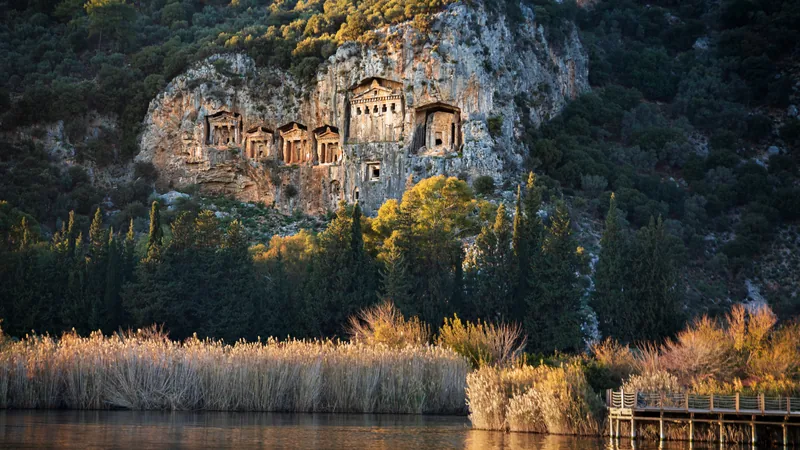
The five must-see rock-tomb sites are Myra, Xanthos, Tlos, Fethiye and Pinara. Three days minimum to do them justice, five if you want to combine with the non-tomb Lycian highlights (Kekova, Patara, Mt Chimaera). Hire a local Lycian-speciality guide for one of the days — they read the carvings differently from any printed guidebook.
Lycian rock tombs are the architectural signature of ancient Lycia and one of the only Mediterranean tomb traditions you can’t see anywhere else. They’re also more accessible than most ancient architecture — you can climb up, walk inside, sit in chambers cut 2,400 years ago. The trick is knowing which sites concentrate the best examples (most ancient cities have one or two; only five have major rock-tomb concentrations) and how to read the architecture once you’re there.
The four types of Lycian tomb
1. House tombs (the iconic type)
The most distinctive Lycian funerary architecture. House tombs are chambers cut into vertical limestone cliffs, with carved facades that imitate the contemporary wooden architecture of Lycian living houses — column-on-column construction, beam-end terminals, pediment tops, sometimes carved doors with mock-handles. The chamber inside is typically 2–4 metres deep with a single carved stone bench (or two or three) where the body was laid. Best examples: Myra (the photograph), Tlos, Pinara, Antiphellos (Kaş).
2. Pillar tombs
Square stone monuments, typically 4–8 metres tall, with the burial chamber at the top of the pillar (rather than at ground level) — emphasizing the Lycian preference for elevated burials. The pillar surfaces are often carved with relief panels and inscriptions. Best examples: the Xanthian Obelisk and the Harpy Tomb (Xanthos), the Tomb of Payava (originals in the British Museum), the Lion Pillar at Patara. Few have survived intact because their above-ground location made them easier to dismantle for building stone.
3. Sarcophagi
Free-standing stone coffins with distinctive pointed-arch lids that imitate the inverted-keel shape of a Lycian wooden boat — a uniquely Lycian variant of the Mediterranean sarcophagus tradition. Many are decorated with relief carvings (warriors, hunting scenes, animal heads) and Lycian-script inscriptions. Best examples: the Antiphellos sarcophagus (Kaş town centre, 4th c. BC), the Üçağız sarcophagi (some now half-submerged at Kekova), the necropolis sarcophagi at Patara and Tlos. Continued in production into the Roman period.
4. Pigeon-hole tombs
A late-Lycian variant — small chamber tombs cut in dense rows into cliff faces, creating honeycomb patterns visible from a distance. Each “pigeon hole” is a small (1m × 1m) chamber for a single body. The form is most-developed at Pinara, where hundreds of pigeon-hole tombs cover an entire cliff face. Less architecturally elaborate than the larger house tombs but visually distinctive.
The seven best Lycian rock-tomb sites
Myra — the photograph
The single most-photographed Lycian rock-tomb cliff. Dozens of house-style tombs cut into a vertical limestone face above a Roman theatre. Includes the “Painted Tomb” with surviving traces of red and blue pigment. Walk up to the foot of the cliff; bring a zoom lens for the upper tombs. Combine with the St Nicholas Church and a Kekova boat day. The starter site for any Lycian-tomb trip.
Read the Myra guide →Xanthos — the Harpy Tomb & the British Museum casts
The political capital of ancient Lycia. The famous Harpy Tomb pillar — a 7-metre stone monument — has had its original ~470 BC carved relief panels in the British Museum since 1842; plaster casts are installed at the original location. The Tomb of Payava (also in the BM) has its empty pedestal in situ. The Xanthian Obelisk, with the longest known Lycian-language inscription, also stands. Combine with Letoon and Patara on a 2-day Lycian-capitals block.
Read the Xanthos & Letoon guide →Tlos — the Bellerophon Tomb
Less-visited than Myra and Xanthos. The Bellerophon Tomb on the cliff face has the only known Lycian rock-tomb relief depicting the hero Bellerophon riding the winged horse Pegasus — unique among Lycian tombs. Combine with Saklıkent Gorge for a perfect western Lycia day. Climb to the Byzantine fortress on the summit if your knees allow.
Read the Tlos guide →Fethiye — the Tomb of Amyntas
A single huge rock tomb (4th century BC) cut into the hillside above modern Fethiye, with a temple-style façade at the scale of a small Greek temple — Ionic columns, pediment, the works. Lit at night. The Lycian inscription on the side names Amyntas, son of Hermapias. Reachable by a 10-minute uphill walk from Fethiye centre. ₺50 entry to the immediate tomb area; a smaller free cluster of rock tombs sits on the hillside above. The single most-accessible Lycian rock tomb (no rural drive required).
Read the Fethiye guide →Pinara — the pigeon-hole cliff
Pinara’s defining feature is a 500-metre-wide cliff face honeycombed with hundreds of small “pigeon-hole” tombs — the densest concentration of any Lycian rock-tomb site, visible from a kilometre away. The lower-cliff tombs are accessible by short scrambles. Pinara is much quieter than the famous sites — most visits feel solitary. Includes a Roman theatre, agora, and a major necropolis at the foot of the cliffs.
See Pinara on the sites directory →Kaş (Antiphellos) — the seaside sarcophagus
A huge Lycian sarcophagus on a stone plinth, sitting in the centre of modern Kaş town near the harbour, and a smaller cluster of pillar tombs and rock tombs in the streets and on the cliff above. The Antiphellos Theatre is a 5-minute walk away. Free, all-hours access — Kaş is the only Lycian site where you can have a meal and a glass of wine 10 metres from a 2,400-year-old tomb. See the Kaş guide for the walking tour.
Read the Kaş guide →Kekova — the half-submerged sarcophagus
The signature image of Kekova: a single Lycian sarcophagus sitting in shallow water at the entrance to Üçağız harbour, the lower half submerged after Mediterranean sea-level rise (and earthquake-induced subsidence) over 2,000 years. Only visible from a boat or kayak. Combine with the sunken city of Kekova on the same half-day boat trip. The Lycian rock-cut tombs in the cliffs above Üçağız are reachable on foot.
Read the Kekova guide →Other notable rock-tomb sites
Patara necropolis
Pillar tombs and sarcophagi scattered among the dunes near the ancient harbour. Less spectacular than Myra or Xanthos but uncrowded and atmospheric.
Olympos riverbed tombs
Sarcophagi and house-tomb fragments scattered along the riverbed walking path through the Olympos archaeological site. The setting (deep ravine, river, pine forest) is the draw, more than any single tomb.
Sidyma (off-the-trail)
Inland village above Patara. Small concentrated necropolis with house tombs and a Roman temple converted into a mosque. Worth a half-day for serious archaeology travellers.
Aperlae (sea-floor)
Lycian harbour town near Kekova, partly submerged. Reached by sea kayak from Üçağız or by walking the Lycian Way Stage 10. Sarcophagi above water; harbour walls and house foundations below.
How to plan a Lycian rock-tomb trip
5-day western-eastern circuit (recommended)
Day 1. Land Dalaman. Drive to Fethiye. Tomb of Amyntas at sunset. Overnight Fethiye.
Day 2. Drive to Pinara (45 min) → Tlos (1 hour) → Saklıkent Gorge for lunch + cold-water relief. Overnight Patara.
Day 3. Xanthos and Letoon morning (UNESCO double). Lunch in Patara village. Patara ruins + beach in the afternoon. Overnight Patara.
Day 4. Drive to Kaş (45 min). Antiphellos walking tour: harbour-side sarcophagus, theatre, rock tombs. Afternoon Kekova kayak — half-submerged sarcophagus, sunken Roman city, Üçağız harbour cliff tombs. Overnight Kaş.
Day 5. Drive to Demre (1 hour). Myra ancient city — the cliff-tomb cluster, the Roman theatre, the Painted Tomb. Lunch at Andriake harbour. St Nicholas Church afternoon. Drive to Antalya for evening flight (or overnight).
3-day fast version (highlights only)
Day 1. Fethiye → Tlos → Saklıkent → overnight Patara.
Day 2. Xanthos morning → Patara afternoon → drive to Kaş.
Day 3. Kaş Antiphellos → Kekova kayak → Myra → fly Antalya.
Photographing Lycian tombs
Myra
The vertical cliff faces south-east; best light is early morning (8:30–10am, when the sun rakes across the carved facades from the side). By midday the cliff is overhead-lit and details flatten. Late afternoon backlights the cliff and works for atmospheric silhouettes. Use a moderate telephoto (70–200mm) for the upper-tier tombs.
Xanthos
Photograph the Harpy pillar from the east side at sunset for warm side-light on the casts. The Roman theatre is best from the upper rows; don’t crop out the necropolis below.
Tlos and Pinara
Both reward an early-morning visit (8:30am gate) for cool mountain shadows. Pinara’s pigeon-hole cliff photographs best from the east-side approach with a wide lens.
Fethiye Tomb of Amyntas
Best photographed at blue hour just after sunset when the floodlights come on. The Ionic façade is dramatically lit and the angle from the lower city looks up at it through the cypresses.
What you shouldn’t do
Don’t climb on the carved decoration
The reliefs and inscriptions are 2,400 years old and unprotected at most sites. Touching them deposits skin oils that erode the stone over decades; standing on them dislodges joints. Keep your hands and feet on plain stone surfaces.
Don’t take souvenir “chips”
The number of stones missing from Lycian sites due to 19th-century stone-quarrying is already irreversible damage. Don’t add to it. Removing antiquities from Turkey is also a serious customs offence (5–25 year prison sentence under Turkish law) — even small fragments.
Don’t add graffiti
Self-evident but still a problem at every site. Phone-camera graffiti, modern names carved alongside Lycian inscriptions, the lot. The damage is permanent. Rangers can and do prosecute.
Frequently asked
What is a Lycian rock tomb?
A Lycian rock tomb is a funerary chamber cut directly into a vertical or near-vertical cliff face, with an architectural facade carved in stone in imitation of contemporary wooden architecture (typically Lycian house construction). They date primarily from the 5th–4th centuries BC. The design is unique to ancient Lycia (southwest Turkey) — no other Mediterranean culture cut tombs in this style at this scale.
Where can you see the best Lycian rock tombs?
The five most-significant rock-tomb sites are: Myra — the iconic vertical cliff face; Xanthos — the Harpy Tomb pillar; Tlos — the Bellerophon Tomb with its unique Pegasus relief; Fethiye — the Tomb of Amyntas; and Pinara — hundreds of “pigeon-hole” tombs in honeycombed cliffs. Plus important examples at Kaş (the Antiphellos sarcophagus), Patara, and Kekova (the half-submerged sarcophagus).
Why are Lycian tombs cut into cliffs?
Two reasons. (1) Religious belief — Lycian tradition held that proximity to high places aided the dead’s journey to the afterlife; the higher the tomb, the more honoured the deceased. (2) Practical preservation — cliff tombs are difficult to reach by tomb-robbers, harder to dismantle for building stone, and protected from weathering on three sides by the surrounding rock. The cliff carvings imitate the wooden Lycian houses of the living — an architectural metaphor for the tomb as “eternal house.”
What’s inside a Lycian rock tomb?
Typically a single chamber, 2–4 metres deep, with one or more carved stone benches along the rear and side walls where the deceased’s bodies were laid. Some tombs have multiple chambers stacked vertically. The chambers were often closed with carved stone doors imitating wooden ones, complete with mock door-handles and hinges. Original contents — bodies, grave goods, jewelry, pottery — were systematically looted in antiquity.
Can you go inside Lycian rock tombs?
At most sites, yes — for the lower-cliff tombs. At Myra, Xanthos, Tlos and Pinara, the lower tier of rock tombs is accessible by a short scramble. Tombs at the top of cliffs are not accessible without rope and are off-limits. There are no formal barriers at most sites — entry is at your own risk. Don’t touch the surviving carved decoration; don’t add graffiti; don’t litter.
How do you plan a Lycian rock-tomb itinerary?
Three days minimum to see the major five sites, comfortable in five. Western cluster: Fethiye (Tomb of Amyntas) → Pinara → Xanthos & Letoon → Tlos. Central: Kaş (Antiphellos walking tour) → Patara. Eastern: Üçağız → Kekova → Myra. Hire an accredited Lycian guide for one of the days to read the architecture properly.