Day-trip from Kaş or Olympos. Myra ancient city in the morning (8:30–10am, before coach tours arrive). St Nicholas church late morning. Lunch at Andriake harbour. Afternoon Kekova kayak from Üçağız. Done.
Most foreign visitors do Myra and the St Nicholas Church as a 90-minute coach-tour stop sandwiched between two longer excursions, get the rock tombs in punishing midday sun, miss most of what either site is, and leave underwhelmed. Don’t do that. Either visit early or late, give yourself 2–3 unhurried hours, eat lunch at the harbour, and pair with a Kekova half-day. From a Kaş base it’s the single most rewarding day in eastern Lycia.
The Myra ancient city — what to actually look at
Myra was one of the six most-important cities of ancient Lycia and a major Mediterranean trading port until silting closed its harbour at Andriake in the early Middle Ages. The site occupies an L-shaped wedge below a 90-metre cliff face. There are two main attractions: the Roman theatre and the rock-tomb cluster cut into the cliff above it.
The Roman theatre
The first thing you see entering the site. Built into the natural slope below the rock-tomb cliff, with 35 surviving rows of seating and substantial portions of the scaenae frons (stage building) wall still standing. Reliefs of theatrical masks are carved into stone blocks scattered around the perimeter — many have been moved to museums but a few remain in situ. Climb to the top row for the view back across the orchestra to the cliff face. The acoustics still work — drop a coin on the centre of the stage and you’ll hear it clearly from the upper rows.
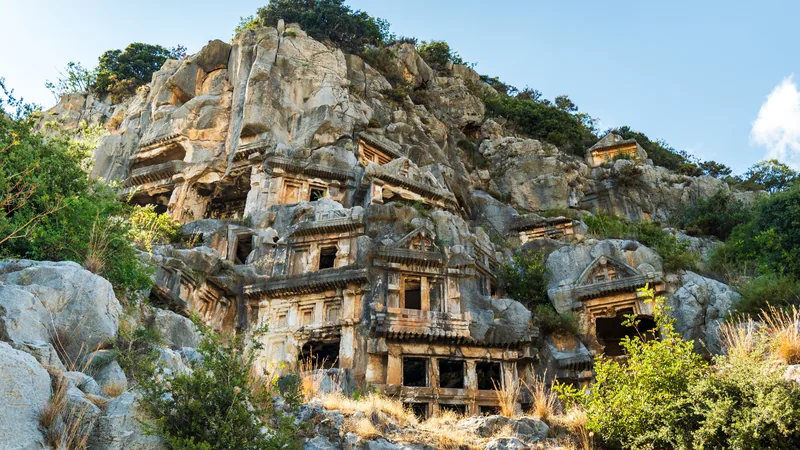
The rock-tomb cluster (the photo)
This is the photograph everyone takes of Myra. A vertical limestone cliff above the theatre, cut with dozens of house-style tombs — square chambers with carved façades imitating Lycian wooden architecture (column-on-column, beam-on-beam, pediments with figural reliefs). The tombs date from roughly 400 BC, predating the Roman theatre by 5–6 centuries. The most famous is the “Painted Tomb” on the upper-right, with surviving traces of red and blue pigment and carved scenes of a family banquet. You can walk to the foot of the cliff but climbing on the tombs is forbidden.
Bring a zoom lens or binoculars for the upper tombs — most of the carving detail is too far to read clearly with the naked eye. Best photo light: early morning (the cliff faces south-east) or late afternoon backlighting. Avoid midday — the sun overhead flattens the carving.
The west cluster (less-visited tombs)
A second, smaller rock-tomb cluster sits 200 metres west of the theatre, signed but not on the main coach-tour route. Less spectacular but more atmospheric — almost no other visitors, no barriers. You can walk right up to the tombs and look inside the chambers. Worth the 15 minutes.
Andriake harbour ruins (1.5 km away)
Few visitors bother but they should. Andriake was Myra’s seaport — site of a major Roman grain warehouse complex still substantially standing (the Hadrian-era horrea is one of the best-preserved Roman granaries in the Mediterranean). The Lycian Civilizations Museum (₺50 / £1.50, 9am–5pm) is here and is genuinely good — the best place outside Antalya Museum to see Lycian artefacts in context. Combine before/after lunch.
The Church of St Nicholas — the historical Santa Claus
The basilica of Saint Nicholas sits in central Demre, 100 metres from the main square and 2 km south of the Myra ancient city. The current structure is mostly 11th-century Byzantine, built on top of a 4th-century original which was the seat of Bishop Nicholas (~315–343 AD). Excavations are ongoing — the church floor is below modern ground level, accessed via stairs.
Who Saint Nicholas actually was
Born in Patara around 270 AD to a wealthy Christian family, orphaned in his teens, ordained Bishop of Myra in 317. He attended the First Council of Nicaea in 325 and (according to one apocryphal but persistent tradition) slapped the heretic Arius across the face during a doctrinal dispute. He was famous in his lifetime for charity — particularly for secret gift-giving, including the most-cited story of throwing three bags of gold through the window of an impoverished family to provide dowries for three sisters who would otherwise have been forced into prostitution.
The gift-giving folklore evolved through Eastern Orthodox veneration into the Russian and Greek “Nikolaos” figure, the Dutch “Sinterklaas,” the German “Sankt Nikolaus” (Christkindl), and ultimately the Anglo-American “Santa Claus.” The red robe, white beard and reindeer sled are 19th-century American invention; the underlying figure is genuinely the bishop of Demre.
He died in Myra in 343 AD. His remains were buried in this church. In 1087 most of his relics were taken from Demre to Bari, Italy by Norman raiders during a moment of Byzantine military weakness; smaller relic fragments were taken to Venice in 1099. The empty original sarcophagus is still in the Demre church — a marble sarcophagus with classical reliefs, partly damaged from the 1087 removal. Enough remains in Demre that DNA analyses have been performed on bone fragments (most recently 2017) to confirm the relics in Bari and Demre share a common origin.
What you actually see
The main basilica — three naves, central apse, surviving 11th-century floor mosaics in the side chapels, and the empty original sarcophagus marked with a brass label. The frescoes on the walls of the side chapels are among the best-preserved Byzantine wall paintings in southern Anatolia (faded, but readable scenes from the life of Christ and the legends of Nicholas). A modern roof covers the entire structure to protect the frescoes from weathering.
Outside the church, in the courtyard, a 2008 bronze statue of Santa Claus (the modern Western version, in red robes, with toy sack) was installed by a local mayor. It is locally controversial — some find it kitsch alongside a serious archaeological site, others welcome the photo opportunity. Take or skip it according to taste.
Service times and visiting
Russian Orthodox and other Orthodox pilgrims visit year-round, particularly on the saint’s feast day (December 6th, the day of Western St Nicholas Day; for Russian Orthodox it’s December 19th by their calendar). On those days expect the church to be full of pilgrims and a service to be running — visiting is still possible but less contemplative. The church operates as a museum, not an active parish, so there are no regular Sunday services.
How to combine — the actual routings
Half-day from Kaş (recommended)
1 hour drive each way. Morning Myra (8:30am gate). Late morning St Nicholas church. Lunch Andriake harbour. Afternoon free or Kekova kayak. Lowest-stress version of the day.
Full day from Olympos / Antalya
2–2.5 hour drive each way. Add Mt Chimaera self-drive on the Antalya version (it’s on the route home). Long day — earliest start gives the best returns.
Combined with Kekova boat
The best single day. Morning Myra + church, lunch at Üçağız harbour, afternoon Kekova half-day boat trip with Lycian sunken-city snorkel. See Kekova guide.
On a Lycian Way section walk
Stage 11 of the Lycian Way ends at Demre. Walkers reach the town on foot from Üçağız over 1 day. Plan a rest day at Demre to do both sites. Stage map + GPX on lycianway.co.uk.
Where to stay if you want a Demre overnight
Most foreign visitors don’t stay in Demre — they day-trip from Kaş, Olympos, or Antalya. But the town has 8–10 small family-run pensions priced €30–60/night including breakfast, and 2–3 mid-range boutique hotels in the €70–120 range. The advantage of a Demre overnight: empty sites at dawn before the coach tours arrive. Disadvantage: Demre town itself is a working agricultural town (greenhouse tomatoes are the local industry), pleasant but not a holiday destination in its own right. See accommodation listings.
Demre town — what else is there
The Andriake harbour and lokantas
The harbour at Andriake (the silted-up ancient port) is now a quiet fishing village with 4–5 family-run fish restaurants. Catch-of-the-day grilled fish, meze plates, Turkish wine — €10–18 for a full meal. Walking distance from the museum. The single best lunch stop on the day-trip route.
The greenhouses
Demre is sometimes nicknamed “Plastic Demre” — the entire valley floor is covered with white-plastic greenhouses producing tomatoes, peppers and aubergines for the Turkish domestic market. It looks distinctive on the drive in. The local industry is what keeps the town economically vibrant outside tourist season.
Beach access
Çayağzı beach (the seafront just south of Andriake) is a 4 km pebble beach used mostly by locals. Free entry, basic café, swimmable. Less developed than Patara, less photogenic, fine for a swim after the ruins.
Best time to visit
Spring (April–May): ideal. Wildflowers around the Myra theatre, mid-20s°C, low crowds.
Summer (June–September): hot. Visit early or late only — midday at Myra is uncomfortable. Higher coach-tour traffic.
Autumn (September–October): excellent. Cooler air, autumn light at the rock-tombs is the photographer’s favourite. Combines well with Kekova while the sea is still warm.
Winter (November–March): sites are open but at reduced hours. Cool and often rainy. Demre town quiet. The St Nicholas Day pilgrimage on December 6th is the busiest day of winter.
Frequently asked
Where is Myra and the St Nicholas Church?
Both are in or just outside Demre town, on Turkey’s south-west Mediterranean coast. Demre is 165 km west of Antalya (2.5 hours by car), 45 km east of Kaş (1 hour). Myra ancient city is 2 km north of central Demre; the St Nicholas Church is in the centre of Demre town, 100 metres from the main square. Both are typically visited on the same half-day trip.
Is the Saint Nicholas in Demre the real Santa Claus?
Yes — Saint Nicholas of Myra (270–343 AD) is the historical figure behind the modern Santa Claus tradition. He was born in Patara and served as Bishop of Myra (modern Demre) for most of his life. The folklore of him secretly giving gifts to the poor evolved over centuries into the Santa Claus / Father Christmas / Sinterklaas figure of December 25th. He died in Demre and was buried in the church that now bears his name.
How much is entry?
Myra ancient city: ₺200 / ~£5 / ~€6. St Nicholas Church: ₺200 / ~£5 / ~€6 (separate ticket; the sites are run as separate museums). The MüzeKart Plus annual pass (~₺1,500) covers both sites plus most other Turkish national parks — worth it if you’re visiting 4+ paid sites on a Lycia trip.
How long do I need to visit?
Half a day — typically 2–3 hours total: 75–90 minutes at Myra (Roman theatre + rock-tomb cluster), 45–60 minutes at the St Nicholas church. Add lunch in Demre. With a return drive from Olympos (1 hour each way) or Kaş (1 hour each way), the whole excursion is a comfortable 5–6 hour day. From Antalya, allow a full day given the 2.5 hour drive each way.
What’s the best time to visit?
Early morning (8:30–10am) or late afternoon (4–6pm). Both sites have minimal shade and the rock-tomb cliff face at Myra reflects heat — midday in summer is uncomfortable. Coach tours from Antalya typically arrive 11am–2pm; you’ll have both sites largely to yourself outside that window. Spring and autumn are best overall. See full month-by-month guide.
Can I combine Myra/St Nicholas with Kekova?
Yes — and it’s the most-recommended combination. Kekova (the sunken Lycian city) is reached from Üçağız or Demre’s port at Andriake, both 15–30 minutes from the Myra/St Nicholas sites. A standard day combines morning Myra + church, lunch at Andriake harbour, afternoon Kekova kayak or boat trip. €60–90 per person for a packaged version; €40–60 if you DIY. See full Kekova guide.