Day-trip from Patara, Kalkan or Fethiye. Xanthos in the late morning, lunch in Kınık village, Letoon in the early afternoon. Combine with Patara’s ruins + beach for a full Lycian-capital day. Pack a hat — minimal shade.
Most visitors arrive at Xanthos by coach as a 45-minute photo stop, see the Harpy pillar with its plaster casts (the originals are in the British Museum), don’t bother with Letoon, and miss what makes the joint inscription extraordinary. Don’t do that. Take 90 minutes at Xanthos walking the colonnaded street, the Roman acropolis, and the rock-tomb cluster on the hill’s edge. Drive 4 km to Letoon and walk the three sanctuary foundations of Leto, Apollo and Artemis with the springs flooding the site — in winter the lower temple sits under ten centimetres of water and is hauntingly beautiful.
Xanthos — the political capital
Xanthos was the largest and most powerful city of ancient Lycia, perched on a defensible bluff above the Eşen river. Roman historian Appian called it “the heart and head of all Lycia.” The city has the densest concentration of inscribed Lycian pillar tombs and the longest surviving Lycian-language inscription anywhere — the “Xanthian Obelisk,” a 1.4 m granite pillar with 250 lines of Lycian and Greek text.
Why Xanthos matters historically
Xanthos appears in Homer’s Iliad as the home of the Lycian heroes Sarpedon and Glaucus, who fought on the Trojan side. Twice in its history the entire population chose mass suicide rather than surrender — once to the Persian general Harpagos in 540 BC, again to the Romans under Brutus in 42 BC. Each time, the city was rebuilt by survivors who had been outside the walls during the burning. Lycian architecture, language and political organization survived through the Roman period; the Lycian League, with its federal senate and rotating presidency, is documented in Polybius and Strabo and was specifically cited by James Madison in Federalist No. 9 as a model of confederation.
The site was rediscovered for European audiences by Charles Fellows in 1838. He returned in 1842 with HMS Beacon and removed the Harpy Tomb reliefs, the entire Nereid Monument, and parts of the Tomb of Payava — all now in the British Museum’s Lycian Gallery, Room 17. The Turkish government has formally requested their return; British Museum policy as of 2026 is non-return of disputed antiquities.
The Harpy Tomb pillar
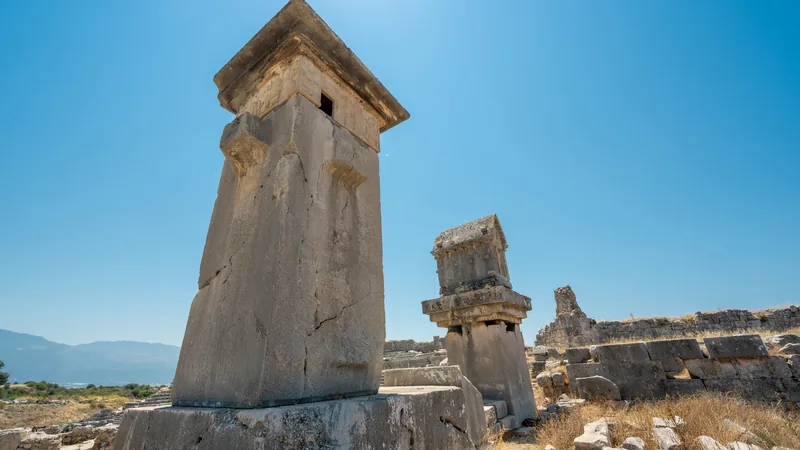
The single most-photographed structure at Xanthos. A 7-metre limestone pillar with carved relief panels at the top showing winged female figures (the “harpies”) carrying small human figures — interpreted as either harpies abducting souls or as the Sirens of Greek mythology. The originals were removed by Charles Fellows in 1842; plaster casts were installed in their original positions in the 1990s by the British Museum, and remain in good condition. Photograph from below at sunset light for the best result.
The Roman theatre
Built into the natural hillside, with substantial surviving rows of seating and a partly-standing scaenae frons. The orchestra is paved with marble. Below the front row are recycled Lycian inscribed blocks built into the foundations — you can see Lycian-script lettering reading horizontally from blocks that originally stood vertically as funerary stelai. Acoustics still functional. Climb to the top row for the view down to the Eşen river plain.
The Roman acropolis
The flat-top of the eastern bluff was the city’s civic and religious centre in Roman times. Surviving structures: the foundations of a 5th-century AD Christian basilica with surviving floor mosaics (under modern protective roof), a colonnaded main street, the Byzantine fortress walls re-using earlier blocks. Walk the main street slowly to see the inscriptions on re-used pillars — most of them name benefactors or magistrates from the 1st-3rd centuries AD.
The Xanthian Obelisk (Lycian script)
A 4-sided granite pillar, originally the central element of a tomb monument, inscribed on all four faces with Lycian text plus 12 lines of Greek. 250 lines total — the longest known Lycian inscription. The Lycian language is an Indo-European language related to Hittite; only ~30% of the obelisk text has been securely translated despite 200 years of philological work. The pillar still stands in situ — you can walk around all four faces.
The rock-tomb cluster
On the eastern edge of the acropolis, a cliff face cut with several rows of Lycian house tombs — typical Lycian funerary architecture imitating wooden building forms in stone, with carved column shafts and beam-end terminals. Walk to the foot of the cliff for the photograph; the upper tombs require some scrambling and aren’t formally accessible.
Letoon — the religious sanctuary
Letoon (sometimes Letöon) is 4 km south of Xanthos in flat fenland near the river. Where Xanthos was the political capital of Lycia, Letoon was its federal religious sanctuary — the location where the Lycian League met annually in religious assembly, dedicated to the goddess Leto and her two children Apollo and Artemis. According to Greek myth, Leto fled here from the jealousy of Zeus’s wife Hera and bathed her newborn twins in the springs that still surface across the site.
The three temples
The defining feature of Letoon. Three temple foundations stand in a row, west to east: the Temple of Leto (largest, central), the Temple of Apollo (with surviving floor mosaic depicting a bow and quiver), and the Temple of Artemis (smallest, eastern). All three are now at or below water-table level; in winter the lower foundations sit in standing water and the surrounding fenland is partly flooded. The flooded look is genuinely affecting — and uncommon at any Mediterranean archaeological site.
The Trilingual Stele (replica on site)
One of the three known Trilingual inscriptions documenting the Lycian language, found at Letoon in 1973. The stele records a religious decree by the Persian satrap establishing a cult of two Caunian gods, with the same text in three scripts. The trilingual format made it the Rosetta Stone of Lycian decipherment. The original is in Fethiye Museum (free entry, worth visiting); a replica with translation panels stands at Letoon.
The theatre
A small Hellenistic theatre in good condition behind the temples — fewer rows than Xanthos but more compact and atmospheric. Surviving relief masks above the entrance gates are notable. Less crowded than Xanthos’s theatre.
The springs and the wading frogs
The site is drained by a network of natural springs that emerge through the limestone bedrock — Greek myth says these are the springs Leto bathed her newborn twins in. They still flow. Frogs are ubiquitous in spring and early summer; the Greek “Frog Chorus” is locally said to derive from a Lycian story of Leto turning some hostile peasants into frogs at this site. In late spring and early summer the chorus is genuinely loud.
How to actually visit — practical detail
The order to visit them
Xanthos first, then Letoon. Xanthos is on the hilltop above Kınık village; Letoon is 4 km south on a side road through farmland. Both are clearly signed from the D400 coastal road. There’s no public transport between the two — you need a car, taxi, or pre-booked transfer.
Tickets and hours
Xanthos: ₺200, 8am–7pm summer / 8am–5pm winter. Letoon: ₺100, same hours. Tickets are sold at each gate; no advance booking needed. The MüzeKart Plus annual pass covers both sites + most other Turkish national parks for ~₺1,500 — great value if you’re visiting 4+ paid sites.
What to bring
Hat + sunscreen — both sites have minimal shade. Water — no shop at Letoon, small kiosk at Xanthos. Sturdy shoes — uneven ground, sometimes wet at Letoon. Camera with a wide-ish lens for the temple-row at Letoon and a moderate zoom for the Harpy pillar reliefs. Insect repellent in spring/summer at Letoon (the springs breed mosquitoes).
What to pair with
Patara — same-day combination
The natural pairing. Xanthos + Letoon morning, lunch in Patara village, Patara ruins + beach in the afternoon. All three sites are 15–30 minutes apart. See Patara guide.
Tlos — eastern combination
Tlos ancient city is 50 minutes drive east of Xanthos and combines well as a 2-day Lycian-capitals trip. Saklıkent Gorge is 15 minutes from Tlos. Combine all three on a 2-day Lycia-archaeology block from a Patara/Kalkan base.
Pinara — quieter inland
Pinara is 30 minutes north of Xanthos, less-visited than the Patara/Xanthos cluster. Distinctive cliff with hundreds of pigeon-hole rock tombs. Add to a 3-day Lycia-archaeology block for full coverage.
Lycian Way Stage 4–5
The Lycian Way passes near Letoon. Section walkers commonly visit on a rest day from a Patara base. See Lycian Way guide.
How to get there
From Patara
15 minutes drive to Letoon, 25 minutes to Xanthos. Best base. No dolmuş; pre-book a half-day transfer (€40–60 round-trip incl. waiting) or rent a car for the day.
From Kalkan
30 minutes to Letoon, 45 minutes to Xanthos. Easy day-trip distance. Half-day private transfer €60–80.
From Fethiye
1 hour to Xanthos, 1h15 to Letoon. Workable as a long day-trip. Combine with Saklıkent or Tlos to justify the drive. Half-day transfer €80–110.
From Kaş
1 hour 15 minutes to Letoon. Day-trip is viable but you’ll want to combine with Patara (in the same direction) to justify the drive. Half-day transfer €100–130.
Best time to visit
Spring (April–May): wildflowers around Xanthos, mid-20s°C, Letoon partially flooded — visually most striking. The frogs at Letoon are at peak loudness.
Summer (June–September): hot. Visit early or late only — Xanthos at midday is uncomfortable. Letoon dry of standing water in late summer.
Autumn (October–November): excellent. Cooler air. Letoon partially refloods after first rains.
Winter (December–March): sites open at reduced hours. Letoon at maximum flooding — the temples sit in 10–20 cm of water and the photography is unmatched. Bring waterproof boots.
Frequently asked
Where are Xanthos and Letoon?
Both sites are in the Eşen valley, in Antalya province, near the coastal town of Kınık — 65 km southeast of Fethiye and 45 km west of Kalkan. Xanthos sits on a hilltop above Kınık; Letoon is 4 km southwest at the foot of the same hill. Both inside the same UNESCO inscription area but require separate ticket purchases. Drive time: 1 hour from Fethiye, 30 minutes from Patara, 45 minutes from Kalkan.
Why are they UNESCO World Heritage sites?
Xanthos and Letoon were jointly inscribed in 1988 as “representing the most unique example of the architecture of the Lycian civilization” — Lycia’s distinctive house-tomb style cut into bedrock, the inscriptions in the Lycian language and script, and the Lycian League’s federal political system. Letoon was the religious heart of the Lycian League — the federal sanctuary of Leto, mother of Apollo and Artemis.
How much is entry?
Xanthos: ₺200 / ~£5 / ~€6. Letoon: ₺100 / ~£2.50 / ~€3 (separate ticket). Combined visiting time roughly 2–2.5 hours. The MüzeKart Plus annual pass (~₺1,500) covers both sites plus most other Turkish national parks.
Where is the Xanthos Harpy Tomb? Is it in the British Museum?
The original carved Harpy Tomb reliefs (~470 BC) were removed from Xanthos to the British Museum by Charles Fellows in 1842 along with the larger Nereid Monument and parts of the Tomb of Payava. They are still on display in London (Room 17, Lycian Gallery). At Xanthos itself, you see the empty pillar tomb and plaster casts of the original reliefs in their original position, made by the British Museum and installed in the 1990s. Turkey has formally requested the originals’ return; the British Museum has so far declined.
How long do I need for both sites?
About 2 to 2.5 hours total: 75–90 minutes at Xanthos, 45–60 minutes at Letoon. Both sites are flat-walked or gently uphill at Xanthos. Add 20 minutes drive time between them. With lunch, comfortable as a half-day from any western Lycia base.
What’s the best base for visiting Xanthos and Letoon?
Patara village is the closest sleepable base (15–25 minutes drive to either site), with the bonus of finishing the day at Patara beach. Kalkan is 30 minutes away with better restaurants. Fethiye is 1 hour and works as a longer day-trip base. Most efficient itinerary: 2 nights in Patara, doing Xanthos+Letoon on day 1 and Patara’s own ruins+beach on day 2. See Patara guide.