Half-day from Antalya. Hadrian’s Gate first, walk the colonnaded street to the central bay, swim 30 minutes off the harbour walls, picnic in the pine woods, walk back via the theatre. Bring snorkel kit; you’ll regret it if you don’t.
Phaselis is the most-underrated archaeological site in Lycia for foreign visitors who’ve heard of Patara and Myra but not this. The geometry alone — three connected bays, one peninsula, ruins-paths through pines — gives a different experience from any other Lycian city. The swim spot in the central bay is genuinely unique on this coast: you stand in clear shallow water with a Roman aqueduct’s submerged piers running underneath you. Pair with a Mt Chimaera evening from a Çıralı or Olympos overnight, or do as a single Antalya day-trip.
The history in 90 seconds
Phaselis was founded by Greek colonists from Rhodes around 690 BC on a peninsula chosen for its three natural harbours — useful for trading in any wind direction. Through the Persian, Hellenistic and Roman periods it remained a wealthy port, exporting timber, perfumed oils, and rose-attar from the Beydağları forests inland. Alexander the Great wintered here in 333 BC. The city peaked under Roman rule in the 1st–3rd centuries AD; Hadrian’s 129 AD visit triggered the construction of the surviving triumphal arch and a major civic-renovation program. Decline came with Arab raids in the 7th–9th centuries; the city was largely abandoned by the 11th century. Excavations began in 1981 under the Antalya Museum and continue.
Notable Phaselis paradox: in classical Greek and Roman literature, the city had a reputation for sharp commercial dealing — “more cunning than the Phaselites” was a Roman proverb. Cicero specifically calls them out for tax evasion. Today the site is more atmospheric than reputational, but the trader-port DNA shows in the geometry.
What to actually look at
Hadrian’s Triumphal Arch
The first major structure most visitors see. A three-arched triple-passage gate built for the emperor Hadrian’s visit — partially restored, original inscription naming Hadrian visible at the base, the lintel re-erected in the 1980s reconstructions. Standing 6 metres tall in its restored form. Photograph from the south side at mid-morning for the best light. The gate marks the formal entry from the harbour-side ruins to the central street.
The colonnaded main street
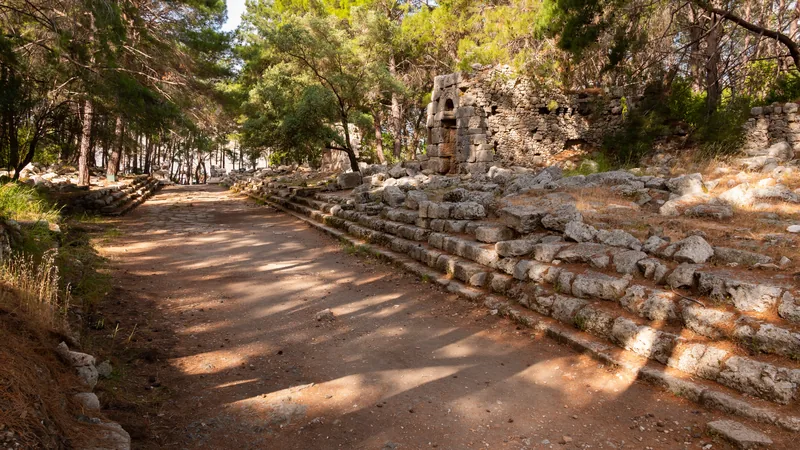
The civic spine of Roman Phaselis — runs from the south bay through the agora to the central bay, passing baths, shops, and an aqueduct. Substantial paving stones survive in situ; many column drums are scattered along the route, several restored to standing position. The street’s alignment gives you the city’s urban logic in 5 minutes of walking. Watch for the carved channel along one edge — that’s the original drainage and water-supply line.
The Roman theatre
Smaller than the theatres at Patara or Myra but in good condition. ~25 surviving rows of seating, partially-standing stage building. The theatre is set back from the main thoroughfare in a quieter pine-forest pocket; few coach tours bother. Climb to the top row for a view across all three bays and out to sea. Acoustics still work.
The aqueduct
One of the more distinctive things at Phaselis. The Roman aqueduct that fed the city ran into the central bay area, with surviving arches still standing on land and several pier-bases visible underwater in shallow water near the central beach. Snorkel out 20 metres and you’ll see them on the seafloor. Genuinely unusual.
The agora and baths
Foundations of the agora (market square), with surviving paving and column bases on three sides; partially excavated bath complex with hypocaust system visible in places. Less spectacular than the gate or street, but worth a slow walk to read the urban plan.
The three bays — what to do at each
South bay (entry side)
The first bay you reach from the gate. Quieter, smaller. Best for a quick swim before walking the ruins, or for the late-afternoon swim if you visited the ruins first.
Central bay (the famous one)
Where most photographs are taken. Wide curved beach, the colonnaded street ends here, the aqueduct’s submerged piers are accessible by snorkel. Most foreign visitors swim here. Can be busy 12–3pm in peak summer.
North bay (quieter)
Smaller, more secluded, often has fewer visitors. The natural breakwater is the city’s old harbour mole — partly submerged, walkable in low water. Good for a quieter swim if the central bay is crowded.
The pine-forest paths
The tracks between the three bays run through old-growth Mediterranean pine forest. Cool even at midday in summer. Wild tortoises occasionally seen. Take the slow walk, not the marked main path.
How to actually visit
Entry, hours, parking
Single gate at the access road from the D400. ₺200 (~£5/€6) per person. Open 8:30am–7pm summer, 8:30am–5pm winter. Free parking at the entrance gate. A free shuttle van runs from the gate to the central bay area in summer (or you can walk in 10 minutes).
What to bring
Water shoes for the swim — the beach has scattered ancient masonry on the seafloor. Snorkel kit for the aqueduct piers and the underwater Roman stones. Swimsuit + towel obviously. Sun cream + hat — most of the ruins-walking is in pine shade but the beach areas are exposed. Picnic lunch — there’s a small café at the gate but no food in the central area, and picnicking in the pine woods is encouraged.
How long
Minimum 2 hours for ruins-only. 4–5 hours if you bring swim kit. Most visitors do 3 hours including a 30-minute swim.
Combine with
Mt Chimaera (perfect pairing)
30 minutes drive. Phaselis in the day, Mt Chimaera evening for the eternal flames. Both inside the same national park, shared MüzeKart pass. Mt Chimaera guide.
Mt Tahtalı cable car
15 minutes drive. The 2,365 m summit of ancient Mt Olympos by cable car from Tekirova. €25 return. Combine in the morning before Phaselis afternoon swim.
Olympos archaeological site
30 minutes drive south. The other famous ruins-and-beach site — different in style, smaller, set in a riverbed. See Olympos guide.
Antalya old town (Kaleiçi)
45 minutes drive north. Walk the harbour, the Roman gate (Hadrian’s Antalya gate, paired with the Phaselis one), eat dinner. Closes the loop on a perfect Antalya day.
How to get there
From Antalya (most common)
Drive south on the D400 coastal highway, ~50 km / 45 min. Free parking at the gate. Public bus from Antalya otogar to Tekirova drops you 1 km from the entrance — easy walk in. Most Antalya organised tours include Phaselis as a half-day; €25–40 per person including transport.
From Olympos / Çıralı
Drive 18 km north on the D400 to the Phaselis turn-off, ~25 minutes. Easy day-trip from these bases. Local minibus services run in season.
From Kemer / Tekirova
The closest sleepable bases. 15–20 minutes. Walking distance from some Tekirova hotels (1.5 km).
From Fethiye / Kaş
3–4 hours each way. Day-tripping is possible but exhausting; better to overnight in Çıralı or Antalya as a stopover.
Best time to visit
Spring (April–May): ideal. Wildflowers in the pine woods, water still cool but swimmable on hot days, mid-20s°C, low crowds.
Summer (June–September): peak. Hot, busy, but the swim makes the heat manageable. Visit early (8:30am gate) or late (after 4pm) for quieter ruins.
Autumn (October): excellent. Sea still 24°C in early October. Crowds thin out. Quiet weekday afternoons are atmospheric.
Winter (November–March): open at reduced hours. Atmospheric in winter rain. Most facilities closed but the ruins stay accessible. The single most photogenic time for serious archaeology photography.
Frequently asked
Where is Phaselis?
Phaselis is a coastal archaeological site in Antalya province, on a small peninsula 4 km north of the resort village of Tekirova. The site is 50 km southwest of Antalya city (45 minutes drive) and 18 km north of Olympos junction (25 minutes drive). The whole site is inside a Turkish national park.
What’s special about Phaselis?
Three things. (1) The geometry — Phaselis was built on a peninsula with three natural harbour bays at its north, south, and central sides, all connected by an ancient colonnaded main street. (2) Hadrian’s Triumphal Arch, built for the emperor’s visit in AD 129. (3) Unlike Patara, Myra or Xanthos where swimming and ruins are separate concerns, at Phaselis you can swim directly off the ancient harbour walls.
How much is entry?
₺200 / ~£5 / ~€6 per person, paid at the gate. Open 8:30am–7pm in summer, 8:30am–5pm in winter. Children under 7 are free. The MüzeKart Plus annual pass (~₺1,500) covers Phaselis plus most other Turkish national-park sites.
How long do I need to visit?
Half a day. Minimum 2 hours for ruins-only; 4–5 hours if you bring swim kit and combine with beach time. Most Antalya day-tour visits allocate 2–2.5 hours which is enough to see Hadrian’s Gate, the main street, the theatre, and have a 30-minute swim.
Can you swim at Phaselis?
Yes — and it’s one of the site’s defining features. Three natural bays, all swimmable. The central bay has the most-photographed swim spot, with a Roman aqueduct’s submerged piers visible underwater. Snorkel kit recommended.
What’s the best base for visiting Phaselis?
Day-trippable from any base in eastern Lycia or Antalya. From Antalya old town: 50 km / 45 min. From Kemer/Tekirova: 15–20 min — closest sleepable base. From Olympos/Çıralı: 30 min drive; combine with Mt Chimaera evening for a perfect Olympos day.