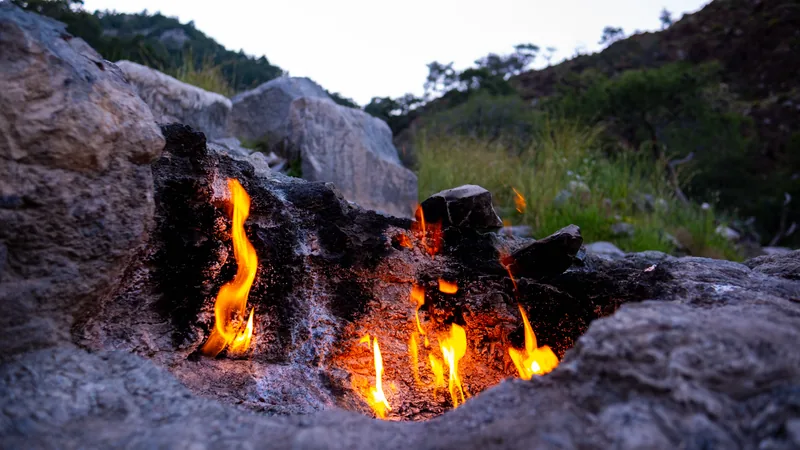
Climb at sunset. Stay 90 minutes after dark. Bring a torch, a fleece, and a small kettle for tea on the flames. Drive yourself or take an Olympos-hostel evening trip.
Most first-timers turn up at 2pm in summer heat, can’t see the flames properly against bright sunshine, take a few photos and leave underwhelmed. Don’t do that. The flames are unimpressive in daylight and properly atmospheric only after dark. Climb up 60–75 minutes before sunset, watch the colour change as dusk falls, sit with the fires for 1–2 hours, then descend with a head-torch. Bring a thermos with hot water + Turkish tea bags + a small kettle and brew on the flames — it’s a tradition locals have done for generations and the rangers don’t mind.
What you actually see
The site is a steeply-sloping limestone hillside roughly 100 m wide by 100 m tall. Methane and other hydrocarbon gases seep through fissures in the underlying serpentine rock — a peridotite-derived rock unusually rich in iron and magnesium that catalyses the spontaneous oxidation of methane on contact with air. The result: small permanent flames burning at vent points, visible as orange-yellow flickering, with little visible smoke. Ground temperature near the flames is genuinely warm. The vent locations shift slightly over years and decades — modern Yanartaş has fewer flames than the site had during 19th-century surveys, but the total methane output remains broadly stable.
The flames are scattered across the hillside in two main clusters, with a few outliers. The lower cluster (closer to the trail entrance) is more accessible; the upper cluster is 5 minutes’ further scramble and usually has more vents. Both clusters are worth visiting. There are no formal viewing platforms — you walk among the rocks, sit on warm stones a metre or so from the flames, and the proximity is the point. The fires don’t throw enough heat to hurt at sitting distance.
The mythological connection
The Chimaera in Greek mythology was a fire-breathing female monster — body of a lion, head of a goat protruding from its back, tail ending in a snake’s head. The hero Bellerophon, riding the winged horse Pegasus, was sent by King Iobates of Lycia to slay her. He killed her by ramming a lance with a lump of lead on the tip down her throat; the monster’s breath melted the lead, choked her, and she fell.
Greek and Roman geographers identified the fire-breathing slopes of Mt Chimaera (the modern Yanartaş) as the actual location of the monster’s lair, citing the genuinely natural flames as physical evidence. Ovid, Pliny the Elder, Strabo and Bishop Methodius all describe the burning rocks; Pliny notes that “the flame is fed neither by wood nor any other combustible matter, but by the rock itself.” Lycia was the kingdom Bellerophon entered to perform his impossible tasks (the “Bellerophonic letter” that condemned him to death by chimera-killing) — and Lycian inscriptions preserve his name (Pelliphons) as a culture-hero. The mythological associations made Yanartaş a religious site for centuries; archaeological evidence shows a small Hephaestus temple on the slope just below the flames.
How to actually visit
The drive and trailhead
From Çıralı village (the main coastal village, with hotels and restaurants), drive 4 km uphill on a paved single-lane road that ends at the Yanartaş car park. Free parking. Ticket office at the foot of the trail (₺120 per person, ₺50 child). Snack kiosk at the trailhead with water, Turkish tea, simple snacks. Public toilets.
The climb
From the car park, a marked path climbs up through pine forest. The path is concrete-paved at first, then transitions to natural rock-step surface. ~150 metres of altitude gain. 25–30 minutes for fit walkers, 35–45 minutes for older or less-fit visitors. The first marked viewpoint reaches the lower flame cluster; a further 5–10 minute scramble reaches the upper cluster. Both worth the extra effort.
What to bring
Sturdy shoes — hiking shoes or trail runners, not flip-flops. The path is uneven rock. Head-torch + spare batteries — essential after dark. Phone torches work but eat your battery and leave hands occupied. Fleece or jumper — temperatures drop fast after sunset on the hillside. Water — at least 1 litre per person. Small kettle + Turkish tea + thermos of hot water if you want to brew on the flames (recommended). Camera with manual settings — the night-photo composition is the photograph.
Brewing tea on the flames — the local custom
It’s a Çıralı tradition to bring a small Turkish-style kettle (a demlik) to Yanartaş and brew tea over one of the flames. The kettle (any small steel kettle works — supermarket kettles, or a Trangia stove kettle) sits on stones placed across a flame; water boils in 5–8 minutes; tea is brewed Turkish-style, strong and dark.
The custom is genuinely local — pension-keepers in Çıralı sell sets of two glasses + tea bags + a small kettle for ₺200 if you don’t have your own. The shared act of brewing and drinking tea with strangers around the flames is one of the actual experiences worth coming for, and not something tour groups generally do. Sit, brew, share. Ranger tolerance for the practice is high; just don’t bring a large camping stove or attempt to cook substantial food.
Combine with what
Olympos ancient city + Çıralı beach
Daytime: walk through the Olympos archaeological site (free if staying in an Olympos hostel; ₺200 day visit), have a swim at Çıralı beach. Evening: drive up to Yanartaş for sunset. The classic Çıralı/Olympos day. See Olympos guide.
Loggerhead turtle nesting (May–Aug)
Çıralı beach is a major loggerhead turtle nesting site. Day-trippers walk the beach path; serious turtle-watchers pre-arrange dawn/dusk turtle walks with the local conservation NGO. The combination of Yanartaş + turtle watching is uniquely Çıralı.
Mt Tahtalı cable car
30 minutes drive south. The 2,365 m summit of Mt Tahtalı (the ancient Mount Olympos itself) reachable by cable car from Tekirova. €25 return for the cable car alone. Daytime activity that pairs well with an evening Yanartaş.
Lycian Way Stage 18
The Lycian Way Stage 18 (Olympos → Çıralı) passes the Yanartaş trailhead. Walkers commonly arrive in Çıralı in the late afternoon and climb to the flames the same evening. Stage map + GPX on lycianway.co.uk; full Lycian Way guide.
How to get there
From Olympos / Çıralı (recommended bases)
Self-drive: 15 min from Çıralı, 25 min from Olympos village including the descent to the coast. Most Olympos hostels run evening Yanartaş trips for ₺250–400 per person including transport in their van; convenient if you don’t have wheels.
From Antalya (1 hour drive)
Day-trip viable but long. Drive south on the D400 toward Olympos; turn off at Beycik junction; descend to Çıralı; up to Yanartaş. Start the day with a Mt Tahtalı cable car ride and end at the flames after dinner. €100–140 private transfer round-trip.
From Kaş or Fethiye
3.5 hours each way from Kaş; 4.5 hours each way from Fethiye. Day-tripping makes no sense — overnight in Çıralı or Olympos.
Where to stay nearby
Çıralı (recommended for couples + families)
Quiet beach village, 4 km below the flames. Small boutique pensions and bungalow camps priced €60–150/night, mostly in citrus orchards near the beach. Çıralı is loggerhead-protected and development-restricted, so no big resorts — the place stays atmospheric. Good restaurants. Walking distance to the Olympos archaeological site (path along the beach). See accommodation.
Olympos village (recommended for backpackers + young couples)
The treehouse-hostel village, 3 km on the other side of the Olympos site. £10–25/night for dorm beds in famous treehouse hostels (Kadir’s, Bayram’s, Saban). Full breakfast + dinner included at most. Lively bar scene at night. Younger and louder than Çıralı.
Best time to visit
Spring (April–May): ideal. Wildflowers on the climb, comfortable temperatures, manageable crowds.
Summer (June–September): hot but the climb at sunset is manageable. Visit later in the evening when the heat drops. Most crowded.
Autumn (October–November): excellent. Cool evenings, fewer crowds, great photography light. Bring a proper jumper.
Winter (December–March): open and atmospheric. Cold and sometimes wet — wear waterproof layers. The flames are most photogenic against winter sky. Gate closes earlier (typically 7pm).
Frequently asked
What is Mt Chimaera (Yanartaş)?
Mt Chimaera (Turkish: Yanartaş, “burning rock”) is a slope on Tahtalı mountain above the village of Çıralı, where natural methane gas seeps through fissures in serpentine rock and ignites spontaneously. 5–25 active vents at any given time, burning year-round on a 100m × 100m hillside. Continuously burning since at least 600 BC, identified in Greek mythology as the breath of the chimera monster slain by Bellerophon.
Where is Mt Chimaera and how do you get there?
Mt Chimaera is above the village of Çıralı, on the eastern Lycian coast about 80 km southwest of Antalya. The trailhead car park is 4 km uphill from Çıralı village. Drive: 1 hour from Antalya, 1.5 hours from Olympos junction, 30 minutes from Çıralı/Olympos villages themselves. From the car park, a 25–30 minute marked path climbs ~150m of altitude up to the main flame field.
When should I go — day or night?
Sunset and after dark, without question. The flames are visible during the day but unimpressive against bright sunlight. After dusk, with the hillside dark and the flames at full visual contrast, it’s properly atmospheric — and the photography only really works at night. Most foreign visitors arrive 1 hour before sunset, hike up while there’s daylight, and stay 1–2 hours after dark. Bring head-torches for the descent.
How much is entry?
₺120 / ~£3 / ~€3.50 per person, paid at the gate. Open until midnight in summer (June–September), until 9pm in shoulder seasons, until 7pm in winter. Children under 7 are free. Parking is free at the trailhead. The MüzeKart Plus annual pass does NOT cover Yanartaş.
Can I cook on the flames?
Officially yes, in moderation, on the marked flame fields. Bringing tea and brewing it on a flame using a small kettle is part of local custom and tolerated. Don’t try to put anything large on the flames — they’re not big — and respect the rangers’ guidance. Don’t try to cover the flames with stones or block them. The flames have been there 2,500+ years; treat them as sacred-adjacent.
Is the climb difficult?
Moderate. About 25–30 minutes of uphill walking from the car park to the main flame field, ascending ~150 metres. The path is marked but uneven — loose rock, some scrambling at the top. Suitable for fit walkers age 8+. Wear sturdy shoes (not flip-flops). After dark a head-torch is essential. Allow 2–3 hours total visit time.